
 Advanced Search
 Tools
Tools Tools
Tools


Soft Architecture, Stasis and Solastalgia. A public exhibition at the Jardin Botanique in Marnay-sur-Seine, 24 - 31 July 2026
Riviere, Sarah  ORCID: https://orcid.org/0009-0006-1629-6370 and Patrinos, Nya
(2026)
The Solastalgia Pavilions: Four Vanishing Plants.
[Exhibition]
ORCID: https://orcid.org/0009-0006-1629-6370 and Patrinos, Nya
(2026)
The Solastalgia Pavilions: Four Vanishing Plants.
[Exhibition]
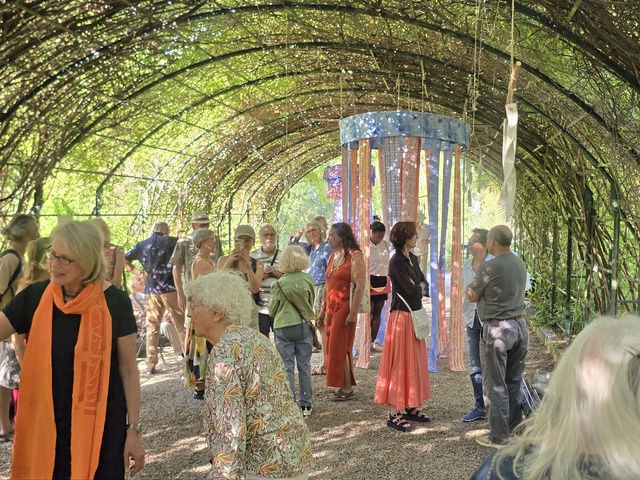 Photograph of the public opening ... | 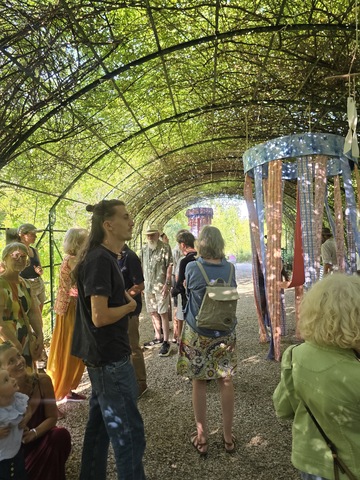 Photograph of the public opening ... | 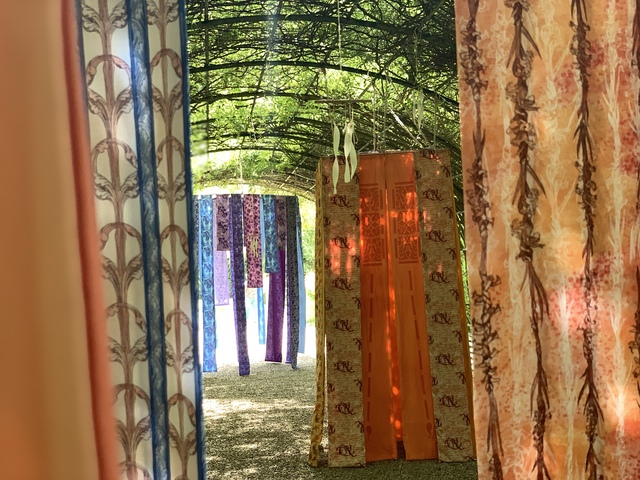 Photograph of the public opening ... |
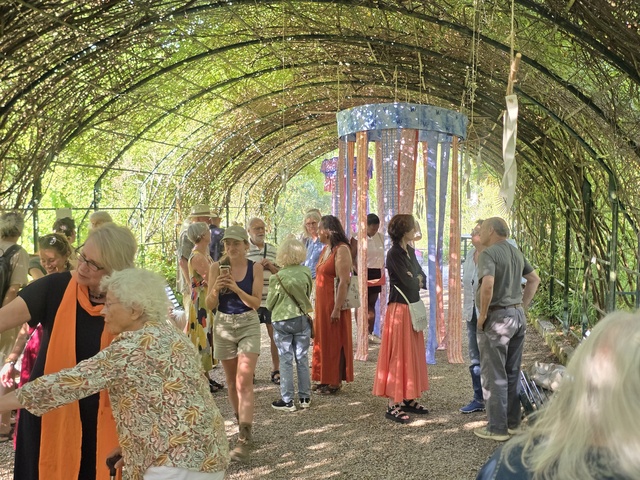 Photograph of the public opening ... | 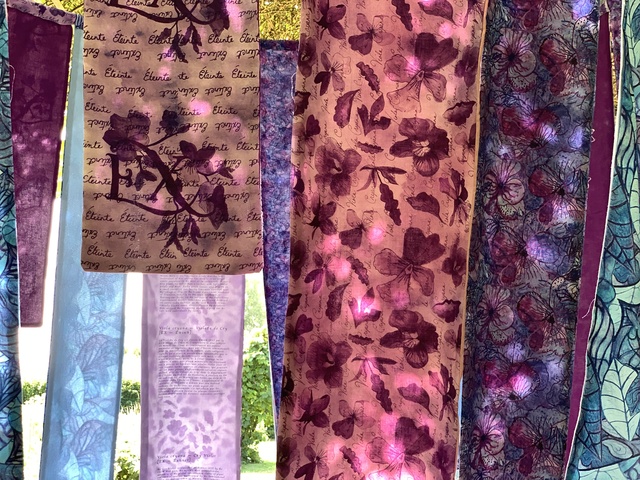 Photograph of the Solastalgia Pav ... |
| Item Type: | Exhibition |
|---|---|
| Event Summary: | Solastalgia Pavilions: Four Vanishing Plants/Jardins Botanique, Marnay-sur-Seine, France /24 - 31st July, 2026 |
| Creators: | Riviere, Sarah and Patrinos, Nya |
| Abstract / Summary: | The Solastalgia Pavilions for Four Vanishing Plants was a public exhibition that took place at the Jardins Botanique in Marnay-sur-Seine, France, 24 – 31 July 2026. The four pavilions are suspended fabric canopies, block-printed with plants that are extinct or nearing extinction. Each of the pavilions is a place where visitors can stop and engage with one specific vulnerable, critically endangered, or extinct plant from the Liste Rouge de la Flore Vasculaire de France Metropolitaine (IUCN, n.d.) and connected with the Aube and surrounding regions. While directly addressing the climate emergency, the pavilions take a very specific approach: they engage with the emotional condition Glenn Albrecht named solastalgia (Albrecht, 2005), distress arising in response to climate disruption, environmental change, and ecological loss (Resurgence & Ecologist, 2023). Reflecting contemporary design approaches and rejecting solution-based proposals, each Solastalgia Pavilion simply holds space for grief, anxiety and loss. They offer no technological solutions, only diverse and communal surfaces on which emotional responses can be held. The four pavilions are meditative spaces for reflection, mourning, renewal, and activation: places to witness loss, to grieve what is disappearing, and to imagine new forms of relationship with the environment. They enable quiet states of mild stasis (Riviere, 2017), places of charged yet located pause, where tensions are held and experienced. In this way, the pavilions are four small arenas on engagement, where ecological loss, memory, joy and anxiety can coexist without resolution, and without descending into paralysis or apathy. In France, tents and canopies have long been part of the ornamental and social life of gardens. During the 17th and 18th centuries, the formal gardens often included temporary pavilions, marquees, and tent-like structures used for fêtes galantes, theatrical performances, and intimate gatherings. These ephemeral architectures, sometimes richly embroidered, other times made of simple canvas, blurred the line between indoors and outdoors, cultivating an atmosphere of leisure, spectacle, and retreat. The methodology of this work links to Ezio Manzini’s approach to making complex or intangible phenomena tangible (Manzini, 2015). Emotions such as solastalgia, climate grief, and eco-anxiety are often unspoken and difficult to express. The pavilions provide material structures through which these feelings can be rendered visible via thread, pigment, and text. Manzini’s concept of “small, local, open, connected” (SLOC) systems offered a useful framework here. As collaborators, Patrinos & Riviere bring together complementary practices in architecture, art and design. Dr Sarah Riviere is an educator at Falmouth University. Her work focuses on social change, ecological design, and participatory spatial practice, combining research, teaching, and international projects with activist-oriented interventions. Nya Patrinos is an artist and designer with an MFA in Scenic Design from the University of California, San Diego. Her work explores colonization, spirituality, identity, and crossed histories through surface and textile design, drawing on geography, memory, and plant humanities. The Practice of Printmaking Outcomes Order of the pavilions along the rose garden (roseraie) in the Jardin Botanique Taxonomy of Species Loss referenced (UICN, n.d.): References Manzini, E. (2015). Design, When Everybody Designs: An Introduction to Design for Social Innovation by (MIT Press, 2015), which outlines the SLOC scenario as a framework for systemic sustainability Resurgence & Ecologist (2023). “What is solastalgia?” in Navigating Climate Anxiety (Resurgence, Issue 341, November / December 2023). [Available at https://theecologist.org/2023/nov/28/what-solastalgia accessed on 28th July 2026] IUCN. International Union for Conservation of Nature. Red List of Threatened Species. [Available at: https://uicn.fr/wp-content/uploads/2019/01/liste-rouge-de-la-flore-vasculaire-de-france-metropolitaine.pdf via this link: https://uicn.fr/liste-rouge-flore/ accessed on 12th April 2026] Rivière, S. (2017). “Stasis, Charging the Space of Change” in FOOTPRINT: Spaces of Conflict, Issue 10(2), 79-94. |
| Contributors: | Contribution Name Falmouth ID UNSPECIFIED Riviere, Sarah 306934 |
| Date: | 24 July 2026 |
| Uncontrolled Keywords: | solastalgia; pavilion; stasis; UICN; vanishing plants; sustainability; textile; canopy; exhibition; botanical garden |
| Subjects: | Architecture Creative Art & Design > Fashion, Textiles & Costume Design Research Sustainability & Environment |
| Department: | School of Architecture, Design & Interiors |
| Depositing User: | Dr Sarah Riviere |
| Date Deposited: | 29 Jul 2026 15:17 |
| Last Modified: | 29 Jul 2026 15:17 |
| URI: | https://repository.falmouth.ac.uk/id/eprint/6556 |
 |
View Record (staff only) |